
GLP-1 Long-Term Side Effects — Proven Facts | SugarWiseLife
GLP-1 long-term side effects are one of the most searched questions once patients reach month four or five of treatment. Around that point, something shifts.
The nausea has mostly faded. The appetite is different in a way that’s become familiar. The scale is moving. And then, quietly, a different question moves in — one that wasn’t there at the beginning.
What does this do to my body if I stay on it?
It’s the right question. And it deserves better than a forum thread or a list of rare adverse events copied from an FDA label.
The honest answer is this: most GLP-1 side effects are your body adjusting, not breaking. The early weeks are front-loaded with discomfort by design — the pharmacology of GLP-1 receptor agonists means the gut, the brain, and the metabolic system are all recalibrating at once. Most of that resolves.
But not all of it.
There is one area — one specific area — where the data flags a real management challenge, not just an adaptation. And there are signals worth knowing about, even if they don’t apply to most people.
Understanding GLP-1 long-term side effects requires separating what stays from what fades— based on clinical trial data, not forum anecdotes. If you’ve been wondering about glp 1 side effects long term, this is the clinical picture as it actually stands.
In this Article
Table of Contents
The Phases — Why Timing Changes Everything
The first mistake most people make when talking about GLP-1 side effects is treating them as a single category.
They aren’t.
There are three distinct phases on GLP-1 therapy, and the side effect profile looks completely different across them. The adaptation phase runs roughly from week one through week sixteen — this is when GI effects peak, when the body recalibrates its hunger signals, and when most of the discomfort that ends up on Reddit was written. The stabilization phase, from month four through month twelve, is when the dust settles. Most GI effects have either resolved or become manageable. The maintenance phase — anything beyond a year — is what the long-term studies are actually measuring.
Conflating these phases is how “GLP-1 long-term side effects” ends up meaning everything from week-two nausea to potential cardiovascular effects at year three. They are not the same conversation.
For a week-by-week breakdown of the early adaptation phase, see How Long Does GLP-1 Take to Work.
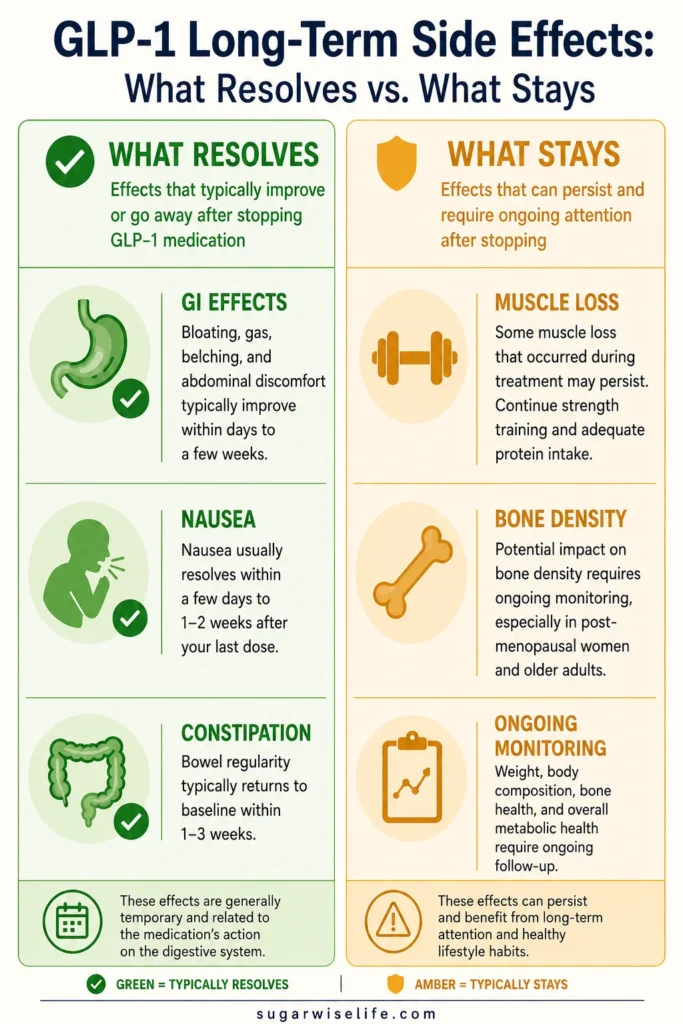
What Resolves — The GI Effects After Month 3
The gastrointestinal side effects of GLP-1 medications — nausea, constipation, reflux, occasional vomiting — are real, well-documented, and front-loaded.
In the major clinical trials (STEP-1 for semaglutide, SURMOUNT-1 for tirzepatide), GI adverse events were most frequent during the titration period and declined significantly over time. A 2024 systematic review by Ghusn et al., covering GLP-1 receptor agonists in obesity, confirmed that gastrointestinal side effects are the primary driver of early discontinuation — but that their intensity decreases substantially past month three for most patients.
By month six, the majority of patients who have stayed on therapy report GI symptoms as manageable rather than disruptive. Some report them as largely resolved. A smaller subset — those on higher maintenance doses, or those with underlying GI sensitivity — continue to experience intermittent symptoms.
What the data shows is not that GI effects disappear completely, but that they stop being the story. The body acclimates to slowed gastric emptying. The enteric nervous system finds a new baseline.
The long-term picture for the GI system is one of progressive improvement — not persistence.
If constipation has been your primary challenge, the six-step clinical protocol is covered in detail in GLP-1 and Constipation — What’s Really Happening and How to Fix It.
What Stays: GLP-1 Long-Term Side Effects on Muscle
Here is where the conversation changes.
Across the major GLP-1 trials, approximately 25 to 40 percent of total weight lost consists of lean mass — muscle, bone, and other non-fat tissue. This is not unique to GLP-1 medications; significant caloric restriction causes lean mass loss in every context. But the magnitude of weight loss achievable on GLP-1 therapy means the absolute amount of muscle at stake is meaningful.
And unlike nausea, this doesn’t resolve on its own.
The mechanism is straightforward: GLP-1 receptor agonists reduce appetite significantly. Patients eat less — often substantially less. If protein intake falls proportionally, the body draws on lean mass to meet its needs. Combine that with a reduction in physical activity that sometimes accompanies early treatment, and the conditions for muscle loss are fully in place.
The 2025 meta-analysis by Li et al. in Diabetes, Metabolic Syndrome and Obesity found that while GLP-1 receptor agonists produce persistent improvements in glycemic control and weight, the effects show some weakening after two years — a finding that likely reflects, in part, compositional changes in what is being lost.
What does active management look like? Two things, neither optional.
Protein intake at 1.2 to 1.6 grams per kilogram of body weight daily. This is the clinical threshold for preserving lean mass under caloric deficit. If food volume is reduced, protein density per meal has to increase — not decrease.
Resistance training, two to three times per week minimum. Not cardio. Not walking, though walking has other benefits. Progressive resistance training that provides the mechanical stimulus lean mass needs to be retained.
A quality protein supplement can make meeting the daily threshold significantly easier — particularly for patients whose reduced appetite makes high-protein meals difficult. Options worth considering are available for review.
The complete framework for managing lean mass on GLP-1 is in the GLP-1 Complete Guide.
This is the one area where passive waiting is not a clinical strategy.
The Safety Signals — Thyroid, Pancreas, and Cancer
Let’s address this directly, because the search data is clear: people are looking for answers about GLP-1 and cancer. They deserve a factual one.
Thyroid
GLP-1 receptor agonists carry an FDA black box warning regarding thyroid C-cell tumors — specifically, medullary thyroid carcinoma (MTC). This warning is based on rodent studies showing dose-dependent thyroid C-cell proliferation at exposures significantly higher than those used in humans. In five-plus years of large-scale human trials — SUSTAIN, STEP, SURMOUNT — the human relevance of these rodent findings has not been determined, per the FDA label. The warning remains on the label as a precautionary measure, not as a reflection of observed human risk. The contraindication is specific: personal or family history of MTC or Multiple Endocrine Neoplasia syndrome type 2.
Pancreas
Early observational data raised questions about pancreatitis risk with GLP-1 therapy. Subsequent larger controlled trials have not confirmed an elevated signal. Kim et al. (2025) noted in their review of GLP-1 receptor agonist side effects that acute pancreatitis events remain rare and comparable to background population rates in most well-controlled studies. The clinical recommendation remains: discontinue if pancreatitis symptoms develop and do not restart.
The Bottom Line
The data deserves to be read, not feared — and not dismissed. For the vast majority of patients without specific risk factors, the available human evidence does not support the conclusion that long-term GLP-1 use meaningfully increases cancer risk. Monitoring remains appropriate. Panic is not.
The Long-Term Effects Nobody Talks About
The side effect conversation tends to focus on what GLP-1 does badly. Here is what it does well — over time, and often unexpectedly.
Cardiovascular
The SELECT trial (Lincoff et al., 2023) demonstrated a 20 percent reduction in major adverse cardiovascular events in obese patients without diabetes on semaglutide. This is not a secondary finding from a weight loss study — it was the primary endpoint. The cardiovascular benefit of semaglutide at the population level is now the most robustly established long-term effect in the entire GLP-1 literature. For a breakdown of the clinical implications, see Semaglutide vs Tirzepatide — What the Data Actually Shows.
Triglycerides and Lipid Profile
Multiple studies document significant reductions in triglycerides and improvements in HDL cholesterol over twelve to twenty-four months of GLP-1 therapy. These changes occur independently of weight loss, suggesting a direct metabolic effect.
Blood Pressure
Modest but consistent reductions in systolic blood pressure are reported across the major trials — typically five to seven mmHg at maintenance dosing.
Cognitive and Neurological
GLP-1 receptors are expressed throughout the brain. Early trial data suggests potential benefits in neuroinflammation and cognitive function. Most of these findings are preliminary; larger trials are ongoing. Worth watching, not yet prescribable. But one has already materialized: tirzepatide earned a landmark approval for sleep apnea — the first concrete outcome from this emerging territory.
If You Stop — What the Data Actually Shows
One of the most searched questions around GLP-1 side effects isn’t about what the medication does — it’s about what happens when it stops.
The data here is consistent. When GLP-1 receptor agonists are discontinued, weight regain occurs — typically within months, and often substantially. The STEP-4 extension trial showed that patients who switched to placebo after achieving weight loss on semaglutide regained approximately two-thirds of their lost weight over the following year. The metabolic adaptations that GLP-1 induces — reduced appetite, slowed gastric emptying, altered food noise — reverse when the drug is removed.
This is not a side effect. It is the pharmacology.
GLP-1 receptor agonists treat obesity as a chronic condition — the same way antihypertensives treat high blood pressure. The question “is it safe to take GLP-1 forever?” is clinically analogous to asking whether it’s safe to take a statin for twenty years. Based on current evidence, the answer is yes — with appropriate monitoring.
Stopping GLP-1 carries no specific withdrawal risk in the pharmacological sense. There is no dependency mechanism. But the metabolic consequences of stopping — weight regain, return of food noise, potential glycemic deterioration — are real and should inform the decision with a clinician.
The goal is not indefinite medication. The goal is metabolic stability. For some patients, those are the same thing.
A Note for Women
Women asking about GLP-1 side effects long term are often focused on two things: hormonal interactions and bone density.
On bone density, the concern is legitimate. Significant weight loss — by any mechanism — is associated with some reduction in bone mineral density, particularly in postmenopausal women who are already at elevated risk for osteoporosis. GLP-1 therapy compounds this risk by contributing to lean mass reduction. The clinical recommendation is not to avoid GLP-1 therapy, but to be proactive: ensure adequate calcium and vitamin D, prioritize resistance training — which benefits bone as well as muscle — and discuss baseline bone density assessment with your physician if you are postmenopausal.
On hormonal interactions: the data on GLP-1 and menstrual cycle regularity, PCOS, and perimenopause is still emerging. Early evidence is cautiously positive, particularly for PCOS.
Hair loss — one of the more distressing side effects in women — has its own dedicated breakdown in GLP-1 and Hair Loss — What’s Really Causing It and What You Can Do.
Conclusion
The early months of GLP-1 therapy are the loudest. The body protests, adapts, protests less. Most of what feels permanent at week six is gone by month six.
What remains — and what asks something of you — is the lean mass question. That is where the work is. Not passive waiting, but deliberate management: protein, resistance, attention.
Everything else the data shows is, if anything, more reassuring than the forums would suggest.
Is it safe to take GLP-1 long term?
Based on current clinical trial data, yes — for most patients without specific contraindications. Five-plus years of large-scale trials show no increased cancer risk in humans, and cardiovascular benefits are well-established. As with any chronic medication, regular monitoring with your physician is appropriate.
How long do GLP-1 long-term side effects last?
Most gastrointestinal side effects — nausea, constipation, reflux — peak during the first four to twelve weeks and resolve substantially by month three to six. Muscle loss is the exception: it requires active management throughout treatment, not just early on.
Do GLP-1 long-term side effects get worse over time?
For the majority of patients, no. GI effects improve as the body adapts to the medication. The main area requiring ongoing attention is lean mass preservation — which worsens with inattention, not with time on the medication itself.
What are the long-term side effects of GLP-1 in women?
Women should pay particular attention to bone density — especially postmenopausal — as weight loss plus lean mass reduction can affect bone mineral density. Resistance training and adequate calcium and vitamin D are important protective factors. Hair loss, while distressing, is typically temporary.
— Dr. Nathan Wells, MD
Physician | 25+ years in clinical and pharmaceutical medicine,
Take good care.
References
Want practical metabolic health insights, weekly? No noise — just evidence-based clarity from a physician. → Subscribe to the SugarWiseLife weekly briefing
This article is for informational purposes only and does not constitute medical advice. The content on SugarWiseLife.com is intended to support, not replace, the relationship between you and your healthcare provider. Dr. Nathan Wells is a pen name used for privacy purposes. Nothing in this article should be used to diagnose or treat a medical condition. Always consult a qualified healthcare professional before making changes to your diet, exercise routine, or medication.