
How to Tell If You Have Insulin Resistance
Insulin resistance symptoms are often subtle, most people don’t walk into a doctor’s office and say “I think I have insulin resistance.” They come in for something else entirely — fatigue that won’t budge, weight that isn’t moving, a blood pressure result that surprised them. They’ve been living with the signals for months or years. They just didn’t know what to call them.
That’s not a personal failure. Insulin resistance doesn’t announce itself. Its early symptoms are easy to explain away — too much stress, not enough sleep, getting older. And standard blood work often looks fine, even when the underlying problem is already well established.
This guide does something different. Rather than listing symptoms in the abstract, it walks you through a practical self-assessment — organized by body system — so you can look at the full picture, not just one piece of it. No single signal is diagnostic. The pattern is what speaks.
If anything here resonates, you’ll also find a clear framework for what to bring to your next medical appointment.
In This Article
Before You Start: How This Guide Works
Insulin resistance is a pattern condition. One symptom in isolation means very little. Five symptoms across different body systems, all pointing in the same direction, means something worth investigating.
As you go through each section below, note honestly which signals apply to you. If it helps, go through it with someone who knows you well — a partner, a close friend. They often notice things you’ve normalized.— not to alarm yourself, but to build an accurate picture. At the end, you’ll know whether a targeted conversation with your healthcare provider makes sense, and exactly what to say.
For a deeper explanation of what insulin resistance actually is and how it develops, the full clinical breakdown is in What Is Insulin Resistance? — The Complete Guide . This article starts where that one ends: with your own body, and what it’s been trying to tell you.
System 1 — Energy & Sleep
These are usually the first signals people notice — and the first ones they dismiss.
After you eat a meal, do you feel noticeably tired within an hour?
Not a mild dip. A real crash — the kind where sitting upright feels like an effort. This happens when the glucose-insulin cycle is dysregulated: blood sugar rises sharply, insulin follows hard, and the resulting drop reads to your body as an energy emergency. The “afternoon slump” is so normalized in American life that most people never question it. It has a metabolic name.
Is your fatigue persistent — present even on days when you’ve slept reasonably well?
When cells aren’t absorbing energy efficiently, no amount of sleep fully compensates. Fatigue that isn’t resolved by rest is different from fatigue caused by poor sleep — though the two often coexist and reinforce each other with insulin resistance.
Do you wake up feeling unrefreshed, even after a full night?
Insulin resistance disrupts cortisol rhythms and sleep architecture in ways that degrade sleep quality without shortening its duration. You sleep your hours. You still wake up tired. These are different problems.
Ask yourself: Is my fatigue explainable — or has it become the background noise of my daily life?
System 2 — Weight & Body Composition
This is where people often arrive with the most frustration — and the least useful advice.
Is your weight concentrated around your abdomen, regardless of your overall size?
The abdominal fat that accompanies insulin resistance isn’t the visible kind you can pinch. It’s visceral — deeper, wrapped around organs, producing inflammatory signals that directly impair insulin function. Someone can appear slim and carry significant visceral fat. Someone else can carry visible weight and have a healthy metabolic profile. Location matters more than total amount.
A practical check: measure your waist at the level of your belly button after a normal exhale. Above 35 inches for women, or 40 inches for men, is associated with meaningfully elevated metabolic risk.
Have you been genuinely trying to lose weight — with diet changes, with more movement — and seen little to no result?
High circulating insulin suppresses fat breakdown and actively promotes fat storage. This is not a willpower issue. It is a hormonal environment working against your efforts. The people who restrict calories faithfully and see nothing happen on the scale are sometimes not failing at dieting — they’re fighting a metabolic current without knowing it.
Have you noticed that your weight distribution has changed over the years — even without significant weight gain?
Fat redistribution toward the abdomen — away from hips, thighs, or general distribution — is a metabolic signal that often precedes anything visible on a blood test.
Ask yourself: Is my body shape shifting in ways that diet and exercise haven’t explained?
System 3 — Hunger & Blood Sugar Signals

These signals are the ones most frequently mistaken for personality traits.
Do you experience intense cravings for sugar or carbohydrates — particularly in the mid-afternoon?
When blood sugar is volatile and cells aren’t absorbing glucose efficiently, the brain perceives an energy shortfall and demands a fast solution. These cravings are physiological. They are not a preference or a weakness. The person who “lacks discipline around sugar” may simply have a blood sugar regulation problem that hasn’t been named yet.
Does your hunger return quickly after meals — sooner than it should?
Normal satiety signals depend on a functioning glucose-insulin cycle. When that cycle is dysregulated, hunger rebounds faster than it should relative to what you’ve eaten. You finish a meal and feel genuinely hungry again an hour later. It isn’t in your head.
Do you feel irritable, anxious, or foggy when a meal is delayed?
The mood instability that comes with hunger — disproportionate irritability, a low-grade anxiety that lifts after eating — is often a sign of blood sugar volatility. A healthy metabolic system can extend meals without distress. A dysregulated one cannot.
Does your thinking feel slower in the afternoon, or cloudier than it did a few years ago?
The brain is acutely sensitive to blood sugar fluctuations. When insulin signaling is impaired, cognitive clarity can suffer — not dramatically, but consistently. Difficulty concentrating, a slowness in retrieving words, a mental heaviness that appears at predictable times of day.
Ask yourself: Are my hunger and energy patterns predictable and manageable — or do they seem to run on their own schedule?
System 4 — Skin Signals
The skin is one of the most visible records of metabolic health— though these changes arrive so gradually they’re easy to miss.. Two signs have a specific, well-documented association with insulin resistance.
Do you have dark, velvety patches of skin in body folds — neck, armpits, groin, or under the breasts?
This is acanthosis nigricans. The darkening and thickening happens because excess insulin stimulates skin cell growth through insulin-like growth factor receptors. It is not a hygiene issue — a misconception that causes real harm. It is a metabolic signal that appears on the surface. More visible in darker skin tones, but present across all skin types.
If you’ve had these patches and no one has connected them to your metabolic health, mention it at your next appointment. They matter.
Do you have multiple small skin tags — particularly on the neck, eyelids, or underarms?
Individually, skin tags are harmless. In multiples, and alongside other signals in this guide, they are part of a recognizable pattern.
Insulin Resistance and Skin Tags →A dedicated article on insulin resistance and skin tags covers this in more detail.
Ask yourself: Have I dismissed skin changes as cosmetic when they may be metabolic?
System 5 — Less Obvious Signals
These ones rarely get connected to blood sugar — but they should.
Has your blood pressure been creeping upward, even with no clear explanation?
Elevated insulin promotes sodium retention in the kidneys and activates the sympathetic nervous system — both of which raise blood pressure. Insulin resistance is increasingly recognized as a driver of what used to be called “essential hypertension” — meaning hypertension with no identified cause. If your numbers are moving in the wrong direction and no one has mentioned metabolic health, it’s a gap worth closing.
For women: irregular periods, unwanted facial or body hair, persistent acne along the jaw?
These are hallmark signs of PCOS, and insulin resistance is almost always part of the underlying picture. Elevated insulin directly stimulates the ovaries to produce excess androgens. Many women spend years treating the symptoms without anyone addressing the metabolic driver.
The specific ways insulin resistance presents in women — through hormonal cycles, perimenopause, fertility — are covered in detail in Insulin Resistance Symptoms in Women
For men: low energy, reduced libido, difficulty maintaining muscle despite training?
These symptoms have multiple causes — but metabolic health is an underappreciated one. Insulin resistance affects testosterone production and the overall hormonal environment in men, often in ways that don’t get investigated.
Ask yourself: Are there symptoms I’ve accepted as unexplained that might have a common metabolic driver?
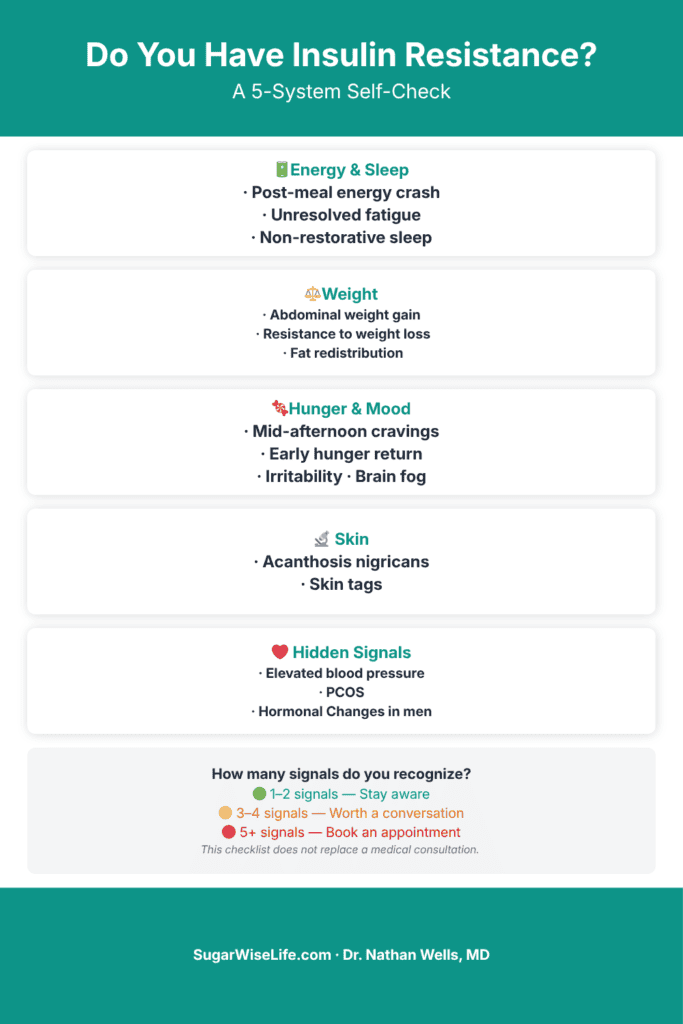
Reading Your Pattern
No single item in this guide confirms insulin resistance. What you’re looking for is accumulation — signals across multiple systems, pointing consistently in the same direction.
1–2 signals | Could be many things. Keep them in mind, but no immediate action required beyond general awareness. |
3–4 signals across 2+ systems | A real pattern. Worth a targeted conversation with your healthcare provider — not urgent, but not something to defer indefinitely. |
5+ signals across 3+ systems | This deserves a specific appointment, with a clear ask. Your body has been communicating something for a while. |
One thing I’ve learned from clinical practice: the people who dismiss this kind of accumulation — who find an explanation for each symptom individually — often look back, years later, and recognize the pattern they missed. Individual explanations can be accurate and still fail to account for what’s happening systemically.
Frequently Asked Questions
What are the signs you are insulin resistant?
The most telling signs appear across multiple body systems: persistent fatigue after meals, abdominal weight that resists effort, intense sugar cravings (especially mid-afternoon), brain fog, irritability when meals are delayed, dark velvety skin patches in body folds (acanthosis nigricans), and small skin tags. No single sign is diagnostic — a pattern across several systems is what warrants investigation.
What are the symptoms of high insulin levels?
Elevated insulin typically causes post-meal energy crashes, accelerated hunger after eating, abdominal fat accumulation, rising blood pressure, and skin changes including darkened patches and skin tags. It can also contribute to mood instability and poor sleep quality. These symptoms often appear years before blood sugar becomes abnormal on a standard test.
What is the root cause of insulin resistance?
Insulin resistance develops from a combination of factors — diet high in refined carbohydrates and processed foods, physical inactivity, chronic stress, poor sleep, excess visceral fat, certain medical conditions (especially thyroid dysfunction), and genetic predisposition. It is the cumulative result of a metabolic environment under sustained strain, not a single cause.
How do you get rid of insulin resistance?
Insulin resistance responds well to consistent lifestyle change: reducing refined carbohydrates and added sugars, regular physical activity (particularly resistance training and post-meal walking), improving sleep, and managing chronic stress. Even modest changes — 5–7% weight loss, 150 minutes of walking per week — produced a 58% reduction in diabetes progression in the landmark Diabetes Prevention Program trial. In some cases, medication adds meaningful support.
What to Say to Your Doctor
The single most useful thing you can do after this self-assessment: ask for a fasting insulin to be added to your next blood panel.
Standard blood work includes fasting glucose — but glucose can look perfectly normal for years while insulin resistance is already established. The pancreas is compensating. The glucose number doesn’t show the strain.
Fasting insulin, measured alongside fasting glucose, allows your provider to calculate HOMA-IR — a validated score that reflects how resistant your cells actually are, independent of whether blood sugar has started to rise.
What to say at your appointment: “I’ve been noticing [describe your 2–3 most consistent signals]. Could we add a fasting insulin to my next blood work? I’d like to know my HOMA-IR.” That’s a reasonable, evidence-based request. Most clinicians will act on it without hesitation. It just isn’t ordered by default. |
Bring the pattern you’ve identified. Bring the specific signals. A list of unrelated complaints is easy to dismiss; a coherent metabolic picture is harder to ignore.

Three signals, four, five — your body doesn’t send noise. It sends information. The question was never whether to listen. It was knowing what to listen for.
You do now. That’s enough to start.
— Dr. Nathan Wells, MD
Physician | 25+ years in clinical and pharmaceutical medicine
Take good care.
Want practical metabolic health insights, weekly? Get your free physician’s guide — “5 Signs You Have Insulin Resistance” — plus evidence-based clarity from a physician, straight to your inbox. → Subscribe to the SugarWiseLife weekly briefing
Medical Disclaimer
This article is for informational purposes only and does not constitute medical advice. The content on SugarWiseLife.com is intended to support, not replace, the relationship between you and your healthcare provider. Dr. Nathan Wells is a pen name used for privacy purposes. Nothing in this article should be used to diagnose or treat a medical condition. Always consult a qualified healthcare professional before making changes to your diet, exercise routine, or medication.
References
2. Spaho A et al. “Risk Factors and Comorbid Conditions Associated with Insulin Resistance: Results from a Cross-sectional Study.” International Journal of Medical Science and Health Research, 2025.